
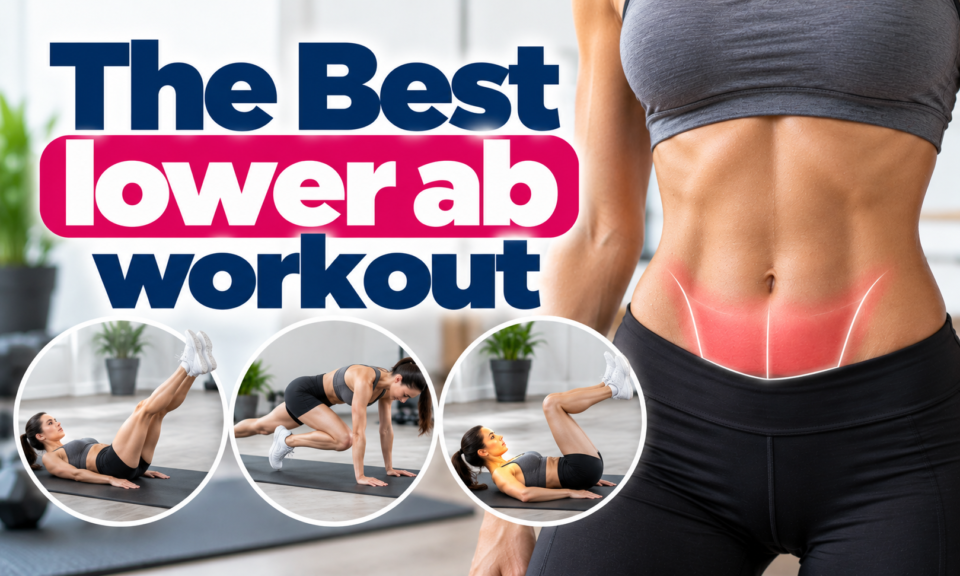
The best lower ab workout does not depend on doing hundreds of crunches. The lower portion of the rectus abdominis is part of the same long abdominal muscle that runs from the ribs toward the pelvis, so you cannot completely isolate a separate “lower ab” muscle. What you can do is choose movements that make the lower portion of the abdominal wall work hard to stabilize the pelvis and resist arching through the lower back.
For most people, a useful routine combines controlled leg-lowering movements, pelvic curls, planks, and full-body training. If visible abs are the goal, exercise also needs to be paired with overall fat loss, nutrition, sleep, and consistent activity. A good starting point is two or three focused core sessions per week rather than training the abs intensely every day.
What actually makes a lower-ab exercise effective?
A lower-ab exercise is effective when you can keep the ribs and pelvis controlled while the legs move. The key sign is that your abdominal muscles stay braced and your lower back does not aggressively arch away from the floor. If the hip flexors take over or the back starts hurting, the exercise is probably too difficult in its current form.
The Healthline lower-ab exercise guide includes leg drops, hip lifts, mountain climbers, scissor kicks, bicycle crunches, and flutter kicks. Those movements can be useful, but quality matters more than speed or rep count.
The best lower ab exercises for most adults
1. Reverse crunch
Lie on your back with knees bent to about 90 degrees. Exhale, gently flatten your lower back, and curl your pelvis toward your ribs so the hips lift slightly from the floor. Lower with control. Avoid swinging the legs.
Suggested dose: 2 to 3 sets of 8 to 15 reps.
2. Dead bug
Lie on your back with hips and knees bent to 90 degrees and arms pointed upward. Brace your core, then slowly extend the opposite arm and leg without letting the lower back arch. Return and switch sides.
Suggested dose: 2 to 3 sets of 6 to 10 reps per side.
3. Bent-knee leg lower
Start on your back with hips and knees bent. Keep your back gently pressed into the floor as you lower one heel toward the ground. Bring it back up before the back arches.
Suggested dose: 2 to 3 sets of 8 to 12 reps per side.
4. Straight-leg raise or leg drop
Raise both legs toward the ceiling, brace the abdomen, and slowly lower them only as far as you can while maintaining control of your lower back. Bend the knees if needed.
Suggested dose: 2 to 3 sets of 6 to 12 reps.
5. Forearm plank
Keep elbows under shoulders and create a straight line from head to heels. Squeeze the glutes and brace the abdomen as if preparing for a gentle punch.
Suggested dose: 2 to 3 holds of 20 to 45 seconds.
6. Mountain climber
From a high plank, bring one knee toward the chest without letting the hips bounce or rotate. Alternate sides slowly at first, then increase speed only if form stays solid.
Suggested dose: 2 to 3 sets of 20 to 40 seconds.
Which exercises should beginners start with?
Beginners usually do better with exercises that let them learn pelvic and rib control before adding long lever movements. Start with dead bugs, bent-knee leg lowers, reverse crunches, and short planks. Once you can complete every rep without holding your breath, jerking the legs, or arching the lower back, progress to straight-leg lowers, flutter kicks, or longer plank variations.
Lower-ab exercise progression
| Level | Exercises | Main goal | When to progress |
| Beginner | Dead bug, bent-knee leg lower, reverse crunch | Learn bracing and pelvic control | You can keep your back controlled for every rep |
| Intermediate | Straight-leg raise, plank, mountain climber | Increase lever length and endurance | You can complete 2 to 3 sets without losing form |
| Advanced | Hollow-body variations, hanging knee raises, slow leg lowers | Build higher core strength and control | Progress resistance or tempo gradually |
A 15-minute lower-ab workout you can actually repeat
This routine works well two or three nonconsecutive days per week. Move slowly enough that you feel the abdominal wall doing the work. Rest about 30 to 60 seconds between exercises as needed.
- Dead bug: 8 reps per side
- Reverse crunch: 10 to 15 reps
- Bent-knee or straight-leg lower: 8 to 12 reps
- Forearm plank: 30 to 45 seconds
- Mountain climber: 30 seconds
Complete 2 to 3 rounds. If you are new to exercise, one or two rounds may be enough at first. Add repetitions, time, or a slightly harder variation only after your technique is consistent.
Can lower-ab exercises burn lower-belly fat?
Ab exercises strengthen the muscles under the fat, but visible lower-ab definition depends heavily on overall body-fat levels and genetics. Research on spot reduction is mixed, so ab exercises should not be expected to selectively remove lower-belly fat.
For body-fat reduction, the strongest practical strategy is still a combination of regular aerobic exercise, resistance training, and nutrition that supports a sustainable calorie deficit when appropriate. A large meta-analysis found that increasing aerobic exercise was associated with reductions in waist circumference, body fat, and both visceral and subcutaneous fat in adults with overweight or obesity. Read the PubMed meta-analysis on aerobic exercise and body composition.
How often should you train your abs?
For most adults, two to four core sessions weekly suffice. Your abs recover like other muscles, and exercises such as squats, carries, presses, and rows challenge the core.
US physical-activity guidance recommends that adults accumulate 150 to 300 minutes of moderate-intensity aerobic activity each week, or 75 to 150 minutes of vigorous activity, plus muscle-strengthening work for all major muscle groups on at least two days per week. See the Physical Activity Guidelines for Americans.
Common mistakes that make lower-ab workouts less effective
- Arching the lower back during leg raises or flutter kicks.
- Using momentum instead of curling the pelvis with the abdominal muscles.
- Pulling on the neck during crunching movements.
- Choosing a difficult variation before mastering basic bracing.
- Rushing repetitions to chase a burning sensation.
- Training abs daily while ignoring full-body strength and aerobic fitness.
- Expecting abdominal exercises alone to create visible definition.
Form problems and quick fixes
| Problem | What it usually means | Try this |
| Lower back arches | The lever is too long or core tension is lost | Bend the knees or reduce range of motion |
| Hip flexors dominate | The pelvis is not staying controlled | Use reverse crunches or dead bugs first |
| Neck feels strained | Too much pulling through the head and shoulders | Support the head lightly and reduce crunch range |
| Form breaks near the end | Fatigue is exceeding current capacity | Stop the set earlier and add volume gradually |
When should you stop or modify lower-ab exercises?
Muscle fatigue is expected, but sharp pain, numbness, tingling, dizziness, or worsening back or hip pain is not. Stop if pain develops. People who are pregnant, recently postpartum, recovering from abdominal surgery, or managing a hernia or persistent pelvic-floor symptoms should ask a qualified healthcare professional about appropriate modifications.
FAQs about the best lower ab workout
What is the single best exercise for lower abs?
There is no single best exercise for everyone. Reverse crunches and controlled leg lowers are excellent options because they train pelvic control and can be scaled easily. The best choice is the one you can perform without back pain or momentum.
Do leg raises work the lower abs?
Yes, leg raises can strongly challenge the abdominal wall, especially when you prevent the lower back from arching. They also involve the hip flexors, so proper pelvic control matters.
How long does it take to see lower-ab definition?
There is no fixed timeline. Strength can improve within weeks, but visible definition depends on body-fat level, genetics, nutrition, sleep, and overall training. For many people, the lower abdomen is one of the last areas where fat loss becomes visually obvious.
Can I train lower abs every day?
You can do light core activation frequently, but hard abdominal training every day is usually unnecessary. Two to four focused sessions per week gives most people enough stimulus while allowing recovery.
Are crunches enough for a complete core workout?
No. A balanced routine should also include movements that resist extension, rotation, and side bending, such as planks, dead bugs, carries, and side planks.
Do I need equipment for a lower-ab workout?
No. Dead bugs, reverse crunches, leg lowers, mountain climbers, and planks can all be performed with body weight. Equipment becomes useful later for adding resistance or variety.
The bottom line
The best lower ab workout is one you can perform consistently with good control. Start with reverse crunches, dead bugs, leg lowers, planks, and mountain climbers, then progress only when your lower back stays stable. For visible definition, combine core work with full-body strength training, aerobic activity, adequate sleep, and nutrition that supports your goals.
